Buying a plot of land is one of the biggest financial decisions most Indian families ever make. Unlike buying a flat or house where you can physically see and touch what you're paying for, a plot purchase involves trusting survey maps, boundary markers, and legal paperwork. This is precisely why RERA (Real Estate Regulatory Authority) registration matters so much for plotted development projects.
Yet, despite RERA being in force since 2016, many buyers still don't fully understand what RERA approval means for plots, how to verify it, or what red flags to watch for. This guide covers everything you need to know as a buyer — from understanding the legal framework to using modern tools like 3D plot visualization to verify that what you're being sold matches the approved layout.
What Is RERA and Why Does It Matter for Plot Buyers?
The Real Estate (Regulation and Development) Act, 2016 — commonly known as RERA — is a landmark legislation designed to protect homebuyers and bring transparency to the Indian real estate sector. While most people associate RERA with apartment buildings and housing societies, it applies equally to plotted development projects.
Before RERA, the plot buying landscape in India was riddled with problems:
- Developers would advertise and sell plots before obtaining necessary approvals, then delay the project indefinitely
- Layout plans would change after buyers had already paid — suddenly the park next to your plot becomes another row of plots
- Money collected from buyers was diverted to other projects, leaving the original project incomplete
- No accountability — buyers had no regulatory body to complain to, only the slow court system
- Misleading advertisements showed amenities and features that were never delivered
RERA changed this by requiring developers to register plotted development projects with the state RERA authority before advertising or selling a single plot. Registration means the developer has submitted the approved layout plan, land title documents, project timeline, and financial details for public scrutiny.
Key fact: Under RERA, any plotted development project with land area exceeding 500 square meters or having more than 8 plots must be registered with the state RERA authority. The developer cannot advertise, market, sell, or accept bookings for any plot without a valid RERA registration number.
What RERA Registration Actually Guarantees
Understanding what RERA registration does (and doesn't) guarantee helps you make informed decisions. Here is what a valid RERA registration means for you as a buyer:
1. Approved Layout Plan Is on Record
The developer has submitted an approved layout plan to the RERA authority. This plan shows the number of plots, their sizes, road widths, common areas, green zones, and amenities. This becomes the official reference — any deviation from this plan is a violation. You can view this approved plan on the RERA portal and compare it with what the developer is showing you.
To understand what to look for in a layout plan, read our guide on how to read land plot maps.
2. Clear Land Title
The developer has declared the status of the land title. While RERA doesn't independently verify title (that remains the buyer's responsibility), the fact that the developer has submitted title documents to a regulatory body adds a layer of accountability. Any misrepresentation of title becomes a punishable offense.
3. Project Timeline Is Fixed
The developer must declare a completion date for the plotted development — including roads, drainage, water supply, electricity lines, and common areas. If the developer fails to complete within this timeline, buyers can claim compensation or a full refund with interest.
4. Money Goes into an Escrow Account
RERA requires that 70% of the money collected from buyers must be deposited in a separate escrow account and can only be used for that specific project's construction and land costs. This prevents developers from diverting your money to other ventures.
5. No Layout Changes Without Consent
The developer cannot make major changes to the approved layout without written consent from at least two-thirds of the allottees and prior approval from the RERA authority. This protects you from post-purchase layout alterations that could affect your plot's value or accessibility.
6. Complaint Mechanism
If the developer violates any RERA provisions, you can file a complaint with the RERA authority for fast-track resolution. This is significantly faster and more affordable than the civil court system.
How to Verify RERA Registration: Step-by-Step
Verifying RERA registration is straightforward, but you need to know where to look and what to check. Follow these steps:
Step 1: Get the RERA Registration Number
Ask the developer or broker for the RERA registration number. This is a unique alphanumeric code assigned to the project. It must appear in all advertisements, brochures, and marketing materials. If the developer hesitates to provide it or says the project is "RERA exempt," treat it as a red flag until you independently verify the exemption.
Step 2: Visit the State RERA Portal
Go to your state's official RERA website. Each state has its own portal. Search for the project using the RERA number, project name, or developer name. The portal will display project details including registration status, approved layout, developer information, and project timeline.
Step 3: Cross-Check Project Details
Compare the details on the RERA portal with what the developer has shown you. Check: total number of plots, plot sizes, road widths, common areas, amenities promised, completion date, and land title details. Any discrepancy between the RERA portal and the developer's presentation is a serious concern.
Step 4: Verify the Approved Layout Plan
Download the approved layout plan from the RERA portal and compare it with the plan the developer is marketing. The plot numbering, road positions, boundary lines, and common areas should match exactly. Using a 3D plot view can make this comparison much easier — you can visually verify that every boundary and measurement in the 3D model matches the RERA-approved layout.
Step 5: Check for Complaints
Most RERA portals also display complaints filed against projects. Check if there are any pending complaints against the developer or the specific project. Multiple complaints about the same issue (e.g., layout changes, delayed completion) are a clear warning sign.
State-Wise RERA Portals: Where to Check
Each Indian state has its own RERA authority and portal. Here are the official portals for major states:
| State | RERA Portal | Key Notes |
|---|---|---|
| Gujarat | gujrera.gujarat.gov.in | GujRERA; active enforcement, covers plotted developments |
| Maharashtra | maharera.maharashtra.gov.in | MahaRERA; one of the most active RERA authorities in India |
| Karnataka | rera.karnataka.gov.in | K-RERA; covers Bangalore and all major cities |
| Tamil Nadu | tnrera.in | TNRERA; mandatory for plotted developments above threshold |
| Rajasthan | rera.rajasthan.gov.in | Raj-RERA; growing number of registered plotted projects |
| Uttar Pradesh | up-rera.in | UP-RERA; separate authority for NCR projects |
| Madhya Pradesh | rera.mp.gov.in | MP-RERA; active in Indore, Bhopal regions |
| Telangana | rera.telangana.gov.in | TS-RERA; covers Hyderabad metropolitan area |
| West Bengal | wbhira.gov.in | HIRA (West Bengal uses different name); covers Kolkata region |
| Kerala | rera.kerala.gov.in | K-RERA; relatively newer enforcement |
Important: Always use the official government RERA portal for your state. Several fake or unofficial websites mimic RERA portals. Look for the .gov.in domain or verify the URL from the state government's official website.
Essential Documents to Check Before Buying a RERA Approved Plot
RERA registration is necessary but not sufficient. As a diligent buyer, you should verify these documents independently, even for RERA-registered projects:
1. RERA Registration Certificate
Obtain a copy of the actual RERA registration certificate. Verify the registration number, project name, developer details, and validity period. The certificate should match what's shown on the RERA portal.
2. Approved Layout Plan
Get the layout plan approved by the local planning authority (Town Planning department, municipal corporation, or development authority). This is different from the marketing brochure layout. The approved plan carries an official stamp and approval number. Compare it with the RERA-registered plan — they should be identical. If you need help understanding layout plans, our guide on how to read land plot maps explains every symbol and marking.
3. Land Record (7/12 Extract or Equivalent)
The 7/12 extract (in Maharashtra and Gujarat) or its equivalent in other states shows land ownership details, survey number, area, and any encumbrances. Verify that the developer is listed as the owner or has a registered development agreement with the landowner.
4. NA (Non-Agricultural) Conversion Order
If the land was originally agricultural, it must be converted to non-agricultural (NA) use before plots can be sold for residential purposes. Verify the NA order number and check that it covers the entire project area.
5. Title Search Report
Get a title search report from an independent lawyer. This report traces the ownership history for the past 30+ years and identifies any legal disputes, liens, mortgages, or claims on the land. Never rely solely on the developer's assurance of "clear title."
6. Encumbrance Certificate (EC)
The EC from the sub-registrar's office confirms that the property is free from any monetary or legal liabilities. Get an EC for at least the last 15-20 years to ensure no hidden encumbrances.
7. Commencement Certificate
For plotted developments, the developer should have a commencement certificate from the local authority permitting them to begin development work (roads, drainage, etc.).
8. Builder-Buyer Agreement
RERA mandates a standard format for the agreement between developer and buyer. Review this agreement carefully — it should include the plot specifications, price, payment schedule, possession date, penalty clauses, and provisions for layout changes. Have a lawyer review it before signing.
For more on what to physically verify at the site, see 5 things to check in a plot layout before buying land.
Red Flags: Warning Signs of RERA Non-Compliance
Even with RERA in place, some developers try to cut corners. Watch for these warning signs:
- "RERA registration is in process" — This is often an excuse. Under the law, the developer cannot sell or even advertise without registration. If they're already marketing and taking bookings, they're violating RERA.
- No RERA number on advertisements — All marketing materials, including newspaper ads, hoardings, social media posts, and website listings, must display the RERA registration number. Absence is a violation.
- Layout differences between brochure and RERA portal — If the marketing brochure shows a park, clubhouse, or wider roads that don't appear in the RERA-registered layout, the developer is making false promises.
- Pressure to book quickly with cash payments — RERA projects require proper documentation and payments through banking channels. Pressure for cash bookings or "before-RERA pricing" is a red flag.
- "This project is exempt from RERA" — While some small projects (under 500 sq m with fewer than 8 plots) are genuinely exempt, developers sometimes falsely claim exemption for larger projects. Verify independently by checking the land area and plot count.
- Multiple RERA numbers for one project — Some developers split a large project into phases to avoid RERA registration or to hide the true project scope. Verify that the RERA number covers the specific phase you're buying in.
- Developer has complaints on RERA portal — Check the complaints section of the RERA portal. Multiple complaints about delays, layout changes, or refund issues indicate systemic problems.
How 3D Visualization Helps Verify RERA-Approved Layouts
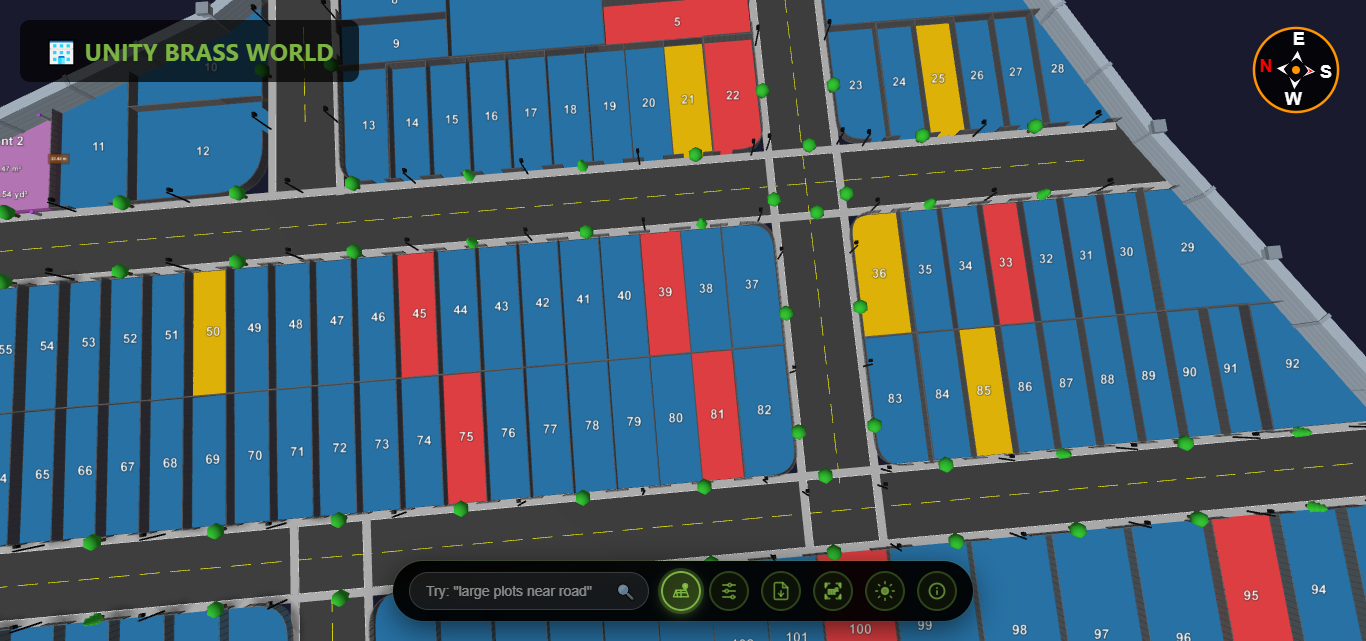
One of the most practical challenges buyers face is verifying that the plot layout shown by the developer matches the RERA-approved plan. Paper maps and PDF layouts are difficult to interpret — boundaries look like random lines, road widths are hard to gauge, and plot sizes are just numbers on paper.
This is where 3D plot visualization becomes invaluable for buyers:
- Visual verification — When a plot layout is converted to an interactive 3D view, you can see every boundary, road, and plot clearly from any angle. Compare this with the approved layout on the RERA portal to spot discrepancies instantly.
- Measurement tools — 3D visualization platforms let you click and measure distances between any two points. Verify that the plot dimensions in the 3D view match the approved layout plan. If your plot is supposed to be 30x40 feet, you can measure it yourself.
- Road width verification — Road widths are critical for property value and legal compliance. In 3D view, you can easily check if the 40-foot road shown in the approved plan is actually 40 feet in the developer's layout.
- Common area identification — Parks, open spaces, and common areas are clearly visible in 3D. If the developer has encroached on common areas to create additional plots (a common RERA violation), it becomes obvious in the 3D view.
- Remote verification for NRI buyers — NRI buyers investing in Indian plots can verify the layout from anywhere in the world using the 3D view, then cross-reference it with the RERA portal.
Read more about the difference between traditional and digital approaches in our comparison of digital 3D maps vs traditional paper maps.
RERA for Plotted Development: What Many Buyers Don't Know
RERA's application to plotted developments has some nuances that even informed buyers often miss:
Agricultural Land Plots Are Not Covered
RERA covers "real estate projects" intended for residential, commercial, or mixed-use development. If someone is selling agricultural land as-is (without creating a plotted layout), RERA may not apply. However, if the seller is subdividing agricultural land into plots and marketing them for residential use, RERA registration is required — even if NA conversion hasn't been done yet. The act of subdividing and marketing triggers the RERA requirement.
Resale Plots in RERA Projects
If you're buying a resale plot (from an allottee, not the developer) in a RERA-registered project, the project's RERA status still protects you. The developer remains responsible for completing the project as per the approved layout and timeline. However, the resale transaction itself between two individuals is not separately regulated by RERA.
Government Land Allotment
Plots allotted by government development authorities (like GIDC, HUDA, BDA, etc.) are typically exempt from RERA because government bodies are the "developers" in these cases. However, if a private developer has purchased land from a government authority and is creating a plotted layout for resale, RERA applies to the private developer's project.
Ongoing Projects
Projects that were ongoing (not completed) when RERA came into effect were required to register within a specified timeframe. If you're buying in an older project that was launched before RERA, check whether it has subsequently registered. Non-registration of an ongoing project is a violation.
The RERA Complaint Process: Your Rights as a Buyer
If you've purchased a plot in a RERA-registered project and the developer violates any terms, here's how the complaint process works:
- File a complaint online through your state's RERA portal. Most portals have an online complaint filing system with a nominal fee (usually Rs. 1,000 - Rs. 5,000).
- The RERA authority issues a notice to the developer and schedules a hearing. Both parties get to present their case.
- The authority passes an order — this could be a directive to the developer to comply, a compensation order, a refund with interest, or penalties.
- If unsatisfied, you can appeal to the RERA Appellate Tribunal within 60 days of the order.
- Non-compliance by the developer can result in penalties up to 5% of the project cost, and imprisonment up to 3 years for repeated violations.
The entire process is designed to be faster than the civil court system, with most complaints resolved within 60-90 days. This speed is one of RERA's biggest advantages for buyers.
Buyer's Checklist: Before You Sign Anything
Use this comprehensive checklist before committing to any RERA-approved plot purchase:
| Verification Item | How to Check | Status |
|---|---|---|
| RERA registration number | Verify on state RERA portal | Must be active and valid |
| Approved layout plan | Download from RERA portal, compare with developer's version | Must match exactly |
| Land title documents | Independent lawyer title search | Clear title, no disputes |
| NA conversion order | Verify order number with tehsil office | Must cover project area |
| Encumbrance certificate | Obtain from sub-registrar (last 15+ years) | No encumbrances |
| Developer's track record | Check RERA portal for complaints, Google reviews | No major complaints |
| Project completion timeline | RERA portal shows declared completion date | Realistic timeline |
| Plot measurements | Physical survey + 3D verification | Matches approved plan |
| Road widths and access | Verify on approved plan and at site | Matches as promised |
| Builder-buyer agreement | Lawyer review before signing | Fair terms, RERA compliant |
RERA and the Future of Plot Buying in India
RERA has fundamentally changed the plot buying experience in India, but the regulation is still evolving. Several developments are making the system even more buyer-friendly:
- Digital integration — State RERA authorities are increasingly making project documents available digitally, including layout plans, approval certificates, and quarterly progress reports. This allows buyers to do thorough due diligence from home.
- 3D layout submission — Some progressive states are beginning to accept or encourage 3D plot visualizations alongside traditional 2D plans for RERA registration. This would make layout verification significantly easier for buyers.
- Stricter enforcement — RERA authorities are becoming more active in taking suo motu action against non-compliant developers, rather than waiting for buyer complaints.
- Technology adoption — The integration of survey data with 3D visualization is creating a more transparent ecosystem where what buyers see is exactly what they get.
For developers and brokers who embrace this transparency, the opportunity is immense. Buyers are actively seeking RERA-registered projects with clear documentation and modern visualization tools. Developers who use modern plot marketing tools alongside RERA compliance are closing deals faster. See how developers are leveraging technology through Plotex for builders and Plotex for brokers.
Frequently Asked Questions
Is RERA registration mandatory for plotted development projects?
Yes, RERA registration is mandatory for plotted development projects where the land area exceeds 500 square meters or has more than 8 plots. Developers must register with the state RERA authority before advertising or selling any plot. Projects below this threshold may be exempt, but buyers should still verify compliance with local regulations.
How can I verify if a plot is RERA approved?
Visit your state's RERA portal (e.g., gujrera.gujarat.gov.in for Gujarat, maharera.maharashtra.gov.in for Maharashtra). Search using the RERA registration number, project name, or developer name. The portal shows project details including registration status, approved layout plan, completion timeline, and developer information. Always cross-check the RERA number in advertisements with the official portal.
What documents should I check before buying a RERA approved plot?
Essential documents include: RERA registration certificate, approved layout plan, 7/12 extract (land record), NA conversion order, title search report, encumbrance certificate, sale deed of previous transactions, and the builder-buyer agreement. Also verify that the layout plan registered with RERA matches the actual plot boundaries — tools like 3D plot visualization can help verify layout accuracy.
Can a developer change the plot layout after RERA registration?
Under RERA, a developer cannot make major changes to the approved layout without written consent from at least two-thirds of allottees and prior approval from the RERA authority. Minor changes that don't affect plot boundaries or common areas may be permitted. If you notice any discrepancy between the RERA-registered layout and what the developer is showing you, report it to the RERA authority immediately.
What happens if I buy a plot in a non-RERA registered project?
Buying a plot in a non-RERA registered project (where registration is required) means you have no legal protection under the RERA Act. You cannot file complaints with the RERA authority for delays, layout changes, or fraud. The developer faces penalties up to 10% of the project cost for not registering, and imprisonment up to 3 years for repeated offenses. Always insist on RERA registration before making any payment.
Protect Your Investment
Buying a RERA-approved plot is significantly safer than buying in an unregistered project, but RERA registration alone is not a guarantee against all risks. You still need to do your own due diligence — verify documents, get an independent title search, physically inspect the site, and compare the approved layout with what's being marketed.
Modern tools make this verification process easier than ever. When a developer provides an interactive 3D plot view, you can visually verify every boundary, road width, and plot dimension against the RERA-approved layout plan — from the comfort of your home.
The combination of RERA compliance and transparent visualization is the gold standard for safe plot buying in India. Insist on both before you invest.